
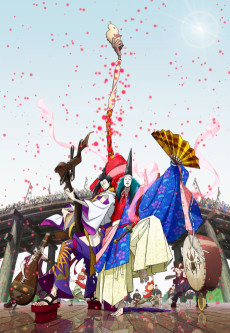
There's a scene that will confuse anyone watching The World Is Dancing without context. A twelve-year-old boy is being drilled in a dance, and he asks the question every beginner asks: why must I step with the left foot here instead of the right?
It sounds like a child being difficult. It's actually the founding question of Japanese theatre — and the boy asking it is real. His name was Oniyasha, and he grew up to become Zeami Motokiyo, the man who turned a rowdy form of village entertainment into Noh, the oldest surviving theatre art on Earth.
Noh has been performed continuously since the 1300s. It predates Shakespeare by two centuries. And almost everything about it is designed to do the opposite of what Western theatre does.
Here's what's actually going on when you watch it.
The two men who invented it

Kan'ami (観阿弥, 1333–1384) was a performer of sarugaku — literally "monkey music," a mix of comic sketches, acrobatics and dance performed at temples and festivals. Low-status entertainment for crowds.
Zeami (世阿弥, c.1363–c.1443) was his son. Childhood name: Oniyasha, "demon child."
The turning point is a real, datable event. Around 1374, Kan'ami staged a sarugaku performance at Imakumano in Kyoto. In the audience was Ashikaga Yoshimitsu, the third Ashikaga shogun — the man who would later build the Golden Pavilion. Zeami was about twelve.
Yoshimitsu was captivated, and became their patron. That single afternoon moved sarugaku from the temple grounds into the shogun's court, and gave Zeami the resources and the audience to spend the next sixty years refining it into something else entirely.
Kan'ami died in 1384, when Zeami was twenty-two. Zeami spent the rest of his life completing what his father started, and — crucially for us — writing it down.
Zeami wrote the theory, and it's still startling
Zeami left more than twenty treatises. The most famous is 風姿花伝 (Fūshikaden), "The Transmission of the Flower of Acting Style." These were secret documents, passed within the family and not published for the public until the twentieth century.
Four of his ideas are worth knowing, because they explain what you're looking at.
花 — "the flower"
Zeami's central metaphor. The flower is the moment a performance becomes genuinely moving to an audience. It isn't skill, and it isn't beauty — a technically flawless performance can have no flower at all. It's the freshness that makes a thing land.
秘すれば花 — "if you hide it, it becomes the flower"
His most quoted line, and often misunderstood as mere secrecy. The full phrase runs: hide it and it is a flower; unhidden it cannot be a flower.
The point is about the audience's expectation. Emotion comes from the unexpected. If the audience knows what technique you are about to deploy, the effect evaporates — so the art must conceal its own mechanism. A performer who shows you how impressive they're being has already lost.
初心忘るべからず — "never forget the beginner's mind"
This is the one modern Japan quotes constantly, usually as "don't forget your original enthusiasm." That's not what Zeami meant.
His shoshin is the incompetent version of yourself at each stage of life. He describes three: the beginner's mind of youth, of each successive age, and of old age. The instruction is to remember precisely how bad you were, permanently, and use it as material. It's a much harsher idea than the motivational-poster version.
離見の見 — "seeing with a detached eye"
The performer must watch themselves from where the audience sits — not feel the performance from inside, but perceive its outline from outside, including from behind. Zeami is asking an actor to hold two viewpoints at once, and warns that without it a performance becomes self-indulgent.
Six hundred years before the concept of the fourth wall, Zeami is describing something closer to a director's eye living inside the actor's body.
What the movements mean
Now the part that makes Noh look, to a newcomer, like nothing is happening.
摺り足 (suriashi) — the slide
Noh actors don't lift their feet. The sole stays in contact with the floor, sliding forward, with the heel rising only slightly at the end of each step. This is why an actor appears to glide.
Two things follow from it. The body stops bobbing, so the figure moves like something not entirely bound by gravity — appropriate, since the lead is often a ghost or a spirit. And the stage itself is built to resonate, so the friction of the foot becomes part of the sound design.
型 (kata) — the fixed forms
There is no improvised gesture. Every movement is a kata, a codified form, and a performance is assembled from them. The audience isn't watching a person behave naturally; they're watching a sequence of known shapes, and reading the meaning in how they're executed.
シオリ (shiori) — how to cry
The most famous example. To weep, a Noh actor raises a hand toward the face, fingers together, not quite touching — the gesture of holding back tears rather than shedding them.
That's it. No sobbing, no contorted face. A single lifted hand is the entire performance of grief, and in the right moment it is devastating precisely because it's so withheld.
The mask is not expressionless
「能面のよう」 — "like a Noh mask" — is Japanese for a blank, unreadable face. This is a slander, and the technique proves it.
The mask is carved with a neutral expression on purpose, so that it can be made to change. The actor tilts it:
- テラス (terasu), "to illuminate" — the face angled slightly up. The mask catches the light and reads as brightness, joy.
- クモラス (kumorasu), "to cloud" — angled slightly down. Shadow falls into the carved features and the same mask reads as sorrow.
One object, no moving parts, and an entire emotional range produced by a few degrees of tilt. Female masks add another trick: the eye holes are cut nearly square rather than round, which blurs the focus of the gaze from the outside and gives the face its characteristic soft, unfixed stare.
When Noh characters cry, the mask is clouded and a hand rises. That's the whole vocabulary, and it's been enough for six centuries.
シテ and ワキ — the two roles
- シテ (shite) is the doer, the protagonist. Usually a ghost, spirit, or god. Wears the mask.
- ワキ (waki) is the side, the witness. Always a living man — often a travelling monk. Never wears a mask.
The structure is almost always the same: the waki arrives somewhere, meets a stranger, and the stranger turns out to be the spirit of someone who died there. The waki's job is to be the audience's proxy, standing in the ordinary world while the shite pulls him into the other one.
This is why so much Noh is a story about a visitor who has to leave — a shape we traced in our piece on Japan's oldest story.
幽玄 — the word for all of it
幽玄 (yūgen) is the aesthetic Zeami was reaching for, and it resists translation. "Subtle profundity," "elegant mystery," "graceful depth" — all of them are approximations.
Practically, it means the effect is stronger when the thing is not shown directly. A flower half-hidden by mist. Grief expressed by one raised hand. A face that changes without changing.
If you've ever wondered why so much Japanese storytelling refuses to state its emotional climax out loud — why the confession goes unsaid, why the camera holds on an empty room — this is the aesthetic bedrock underneath. Zeami wrote the manual in the 1400s.
Where to see it in anime
- The World Is Dancing — the origin story itself, following Oniyasha/Zeami. Its whole premise is a boy demanding to know why the forms are the way they are.
- Inu-Oh — Masaaki Yuasa's film about a deformed Noh performer in the same era, staged as a glam-rock concert. Historically loose, spiritually on target, and the best possible companion piece. (Inu-Oh was a real 14th-century performer, and he appears in The World Is Dancing too.)
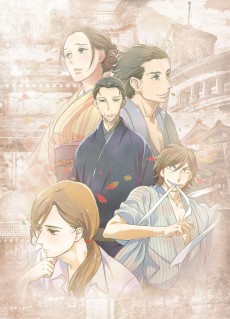
- Showa Genroku Rakugo Shinju — not Noh but rakugo, and the finest anime ever made about inheriting a traditional art: the forms, the lineage, the terror of not being good enough for it.
- Chihayafuru, Hikaru no Go, Tsurune — the same structure applied to karuta, go and kyūdō: a fixed traditional form, and a young person learning what it's for.
- Welcome to the Ballroom and Blue Period — the shoshin problem in dance and painting.
Why it still matters
Zeami was a child performer who got lucky in front of a shogun, and then spent sixty years asking why one gesture works and another doesn't — and writing the answers down in secret.
The result is a theatre where an actor glides instead of walks, where a wooden face weeps by tilting four degrees, and where the most powerful thing you can do is withhold. Six hundred and fifty years later, it is still performed, largely unchanged.
The next time an anime holds on a still frame instead of showing you the tears, you're watching Zeami's idea, still working.
More culture explainers on AnimeBuzz: Japan's oldest story, the kokuhaku confession, Obon. Or browse the data: all-time rankings, by genre, by tag.
Sources and notes
- 世阿弥 (Wikipedia) and 観阿弥・世阿弥(刀剣ワールド) — dates, the childhood name Oniyasha, the c.1374 Imakumano performance and Yoshimitsu's patronage
- 風姿花伝 (Wikipedia) and 世阿弥のことば(the能ドットコム) — 花 / 秘すれば花 / 初心忘るべからず / 離見の見
- 初心忘るべからずの本当の意味(檜書店) — the three shoshin and why the popular reading is wrong
- テラス / クモラス / シオリ(the能ドットコム 能楽用語事典)— mask tilting and the weeping form
- 女面に特有の造形上の技巧(the能ドットコム) — the squared eye openings on female masks
The World Is Dancing is a dramatized account; where the anime and the historical record differ, this article follows the record.