
"Why is anime always set in high school?"
It's one of the first things people ask, and the usual answers are guesses: Japan is obsessed with youth, the audience is teenagers, studios are lazy. I wanted to check whether the premise was even true, so I counted.
The answer turns out to be more interesting than the question. The stereotype is real, but it isn't about how much school anime gets made.
The numbers

Across the 888 titles in this site's catalogue, 250 carry a School or School Club tag — about 28%. Meaningful, but nowhere near "always."
Now split that by how the titles got into the catalogue, because the two halves are collected differently:
| Set | Titles | School-set |
|---|---|---|
| Everything currently airing (complete seasonal data) | 348 | 15% |
| Past titles, gathered by popularity | 540 | 37% |
| All-time top 100 by community score | 100 | 23% |
And within 2026 specifically, season by season: Winter 15%, Spring 21%, Summer 13%, Autumn 6%.
So of everything actually being produced right now, roughly one title in seven is set in a school. If you only look at the shows that got popular enough to be remembered, it's closer to one in three.
That gap is the whole story. School anime isn't over-produced. It's over-selected.
Something about the setting makes a show disproportionately likely to become one of the ones people keep.
Here's what I think that something is.
1. The uniform is a production shortcut
The most boring reason is also the most powerful.
Character design is one of the most expensive things in an anime. Every character needs an outfit, drawn from every angle, consistent across hundreds of cuts, redrawn by dozens of animators.
A school uniform solves this for the entire cast at once. Design one, and thirty characters are dressed. Everyone is now visually coherent, on-model, and cheap to animate.
It also does an enormous amount of narrative work for free. A uniform tells you instantly: these people are the same age, they belong to the same institution, they occupy the same rank. Change one detail — a ribbon colour, a badge — and you've encoded year group without a line of dialogue.
2. It gives you thirty people who cannot leave
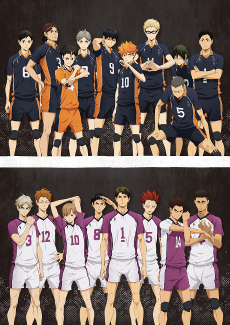
Ensemble stories have a structural problem: you need a reason for the cast to keep being in the same place.
Workplaces work, but adults go home to separate lives. Friend groups drift. Families are too small.
A school class is a group of roughly forty people, the same age, assigned to each other, in one room, every day, for a year — and in Japan it's usually the same room, because teachers rotate and students don't. You didn't choose them and you can't leave.
That's an extraordinary gift to a writer. Every rivalry, crush, misunderstanding and reconciliation has a guaranteed venue and a guaranteed reason for the people involved to see each other tomorrow.
Add the club system on top and you get a second enclosed group, this one self-selected and goal-oriented — which is why so many anime are actually about a club rather than a class.
3. The calendar writes your season structure
A Japanese school year is a fixed sequence, and it's close to identical nationwide: entrance ceremony in April, sports festival, the culture festival, exams, the winter break, graduation in March.
That's a pre-installed three-act structure that repeats annually, and every Japanese viewer already knows the beats. A single line — "the culture festival is next week" — sets up an entire arc with no exposition, because the audience knows what a culture festival demands of the people in it.
Western school stories can't lean on this the same way, because the experience is far less standardised. In Japan the club system, the uniform, the festival calendar and the three-year cycle are close to universal, which means a school is a set the entire audience has personally lived in.
4. Graduation is a free ending
This one is underrated.
Most settings have no natural stopping point. A workplace can go on forever. A fantasy world can always have another war.
School has a hard three-year limit, known in advance, that everyone in the story is walking toward. It's a deadline you can feel from episode one.
That's why so much anime is drenched in a specific flavour of melancholy: the format guarantees that this group of people will be broken up on a known date, no matter what they do. Nothing has to go wrong for it to be sad. It ends because time ends it — which is close to the medium's favourite idea, and the reason a school-set drama can land an emotional finish that a workplace comedy has to manufacture.
5. The hierarchy is pre-installed

Introduce two characters in an office and you have to establish who outranks whom.
In a school, senpai and kōhai does it instantly. One year's difference in age produces a real, binding hierarchy, expressed in how the characters speak to each other before they've said anything of substance.
You get status, tension, obligation and the possibility of transgression, all encoded in the grammar. For free.
6. It's a container, not a genre
This is the part people miss when they call it a cliché. "School" isn't what these shows are about. It's the room they happen in.
Of the 250 school-set titles in our catalogue, here's what they're actually crossed with:
| Comedy | 161 |
|---|---|
| Romance | 130 |
| Slice of Life | 118 |
| Drama | 108 |
| Action | 58 |
| Supernatural | 47 |
| Fantasy | 38 |
| Sports | 33 |
Horror, mecha, psychological thriller, volleyball, mahjong, competitive poetry — all of them work in a school, because the setting costs nothing to establish. The writer spends zero minutes explaining the world and goes straight to the premise.
Even isekai keeps one foot in it: of 96 isekai titles in the catalogue, 10 still tag as school-set, because the protagonist gets pulled out of a classroom. The truck-kun joke exists because "ordinary student" is the default self-image the genre is built to displace.
7. And the manga pipeline points there anyway
Most anime adapts manga, and the biggest manga magazines are aimed at readers who are themselves students. A protagonist the reader's age, in a building the reader is in five days a week, is the path of least resistance — and it has been for fifty years.
That doesn't explain the quality gap on its own. But it explains the supply.
So what does the data actually say

Two things, and they pull in different directions.
The stereotype overstates the volume. Only about one in seven currently airing titles is school-set, and in Autumn 2026 it's one in sixteen. The most common thing in anime right now is not a school; the catalogue's largest tags are urban fantasy, super powers and magic. Isekai alone is 96 titles.
The stereotype is right about what lasts. Among titles popular enough to have been worth cataloguing, it's 37%. The shows that get exported, translated, recommended and remembered skew school-set far more than production does.
Which makes sense given everything above. The setting hands a writer a fixed cast, a fixed calendar, a fixed hierarchy, a guaranteed ending and a free costume budget. That's not a crutch — it's an unusually good set of starting conditions, and shows built on them succeed more often.
You're not seeing a lack of imagination. You're seeing survivorship.
More culture explainers on AnimeBuzz: the school festival system, why bukatsu is so intense, senpai and kōhai, the kokuhaku confession. Or browse the data: all-time rankings, by tag.
Method and caveats
- Counts are from this site's own catalogue of 888 titles as of 2026-08-11, using AniList tags. A title counts as school-set if it carries School or School Club at a tag rank of 50 or above.
- ⚠️ The two halves of the catalogue are not sampled the same way, and the comparison depends on that. Current seasons are collected exhaustively — every airing title, popular or not. Older titles were added by popularity, so that half is a selected set by construction. The 15% vs 37% gap is exactly that difference, which is why it's presented as evidence about selection rather than about production trends over time.
- Tag rank is AniList's community-voted relevance score, so it reflects how strongly viewers associate a title with a setting — not an objective classification.
- Genre cross-counts add to more than 250 because titles carry multiple genres.